









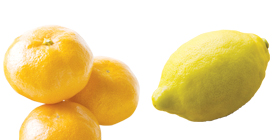
Sometimes referred to as vitamin P due to its ability to reduce capillary permeability, hesperidin is a bioflavonoid found in high concentrations in the whitish rinds of citrus fruits such as mandarin, orange or lemon.
Hesperidin has been the focus of many studies due to the numerous physiological functions it exhibits: improvement of capillary flow, reduction of cholesterol and body fat, alleviation of allergy symptoms, etc. Despite those functions, the low water and alcohol solubility of hesperidin has considerably limited its applications.
Properties of αG Hesperidin
Toyo Sugar Refining Co., Ltd has succeeded in developing and commercially producing glucosyl hesperidin (trade name: αG Hesperidin) using our enzyme technology that enables the transfer of a glucose molecule to native hesperidin. The result is a material that is over 20,000 times more soluble in water than native hesperidin. This enhanced feature opens the door to skin care, foods, beverages, supplements and pharmaceutical applications.
| Hesperidin | αG Hesperidin | |
|---|---|---|
| Solubility (g/100g of water) |
0.002 | 40 |
Physiological functions of αG Hesperidin
By improving capillary flow and protecting arterial walls, alpha glucosyl hesperidin can be used in skin care formulations developed to promote skin rejuvenation. αG Hesperidin also helps lower blood cholesterol, reduce body fat, improve bone density and provide other health benefits.
Enhancement of Vitamin C Action
The proper absorption of ascorbic acid (AsA) can be enhanced by combining it with Alpha Glucosyl Hesperidin. αG Hesperidin is essential for the proper absorption of AsA by increasing its stability and availability.

Sometimes referred to as vitamin P due to its ability to reduce capillary permeability, hesperidin is a bioflavonoid found in high concentrations in the whitish rinds of citrus fruits such as mandarin, orange or lemon.
Hesperidin has been the focus of many studies due to the numerous physiological functions it exhibits: improvement of capillary flow, reduction of cholesterol and body fat, alleviation of allergy symptoms, etc. Despite those functions, the low water and alcohol solubility of hesperidin has considerably limited its applications.
Toyo Sugar Refining Co., Ltd has succeeded in developing and commercially producing glucosyl hesperidin (trade name: αG Hesperidin) using our enzyme technology that enables the transfer of a glucose molecule to native hesperidin. The result is a material that is over 20,000 times more soluble in water than native hesperidin. This enhanced feature opens the door to skin care applications.
Skin Care
The high solubility of Alpha Glucosyl Hesperidin is paired with its antioxidant and radical scavenging properties. The ability of Alpha Glucosyl Hesperidin to improve capillary circulation allows it to stimulate skin surface circulation, which helps improve skin tone, brighten dull complexion, improve the red color of lips and reduce dark circles and crow feet.
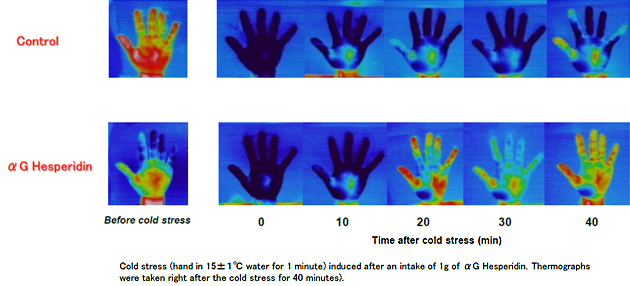
By improving capillary flow, αG Hesperidin PS-CC can alleviate the symptoms of cold feet and hands.

Sometimes referred to as vitamin P due to its ability to reduce capillary permeability, hesperidin is a bioflavonoid found in high concentrations in the whitish rinds of citrus fruits such as mandarin, orange or lemon.
Hesperidin has been the focus of many studies due to the numerous physiological functions it exhibits: improvement of capillary flow, reduction of cholesterol and body fat, alleviation of allergy symptoms, etc. Despite those functions, the low water and alcohol solubility of hesperidin has considerably limited its applications.
Toyo Sugar Refining Co., Ltd has succeeded in developing and commercially producing glucosyl hesperidin (trade name: αG Hesperidin) using our enzyme technology that enables the transfer of a glucose molecule to native hesperidin. The result is a material that is over 20,000 times more soluble in water than native hesperidin. This enhanced feature opens the door to supplements and pharmaceutical applications.
Solubility Enhancement (Pharmaceuticals and Nutraceuticals)
Increasing the solubility and permeability of hardly soluble actives has always been a challenge to pharmaceutical and nutraceutical formulators.
Due to its intrinsic properties and the association it forms with molecules with poor solubility, αG Hesperidin has the ability of sharply increasing the bioavailability of active pharmaceutical ingredients.
αG Hesperidin can also help increase the solubility of hardly soluble flavonoids. One such example is the addition of αG Hesperidin to mandarin orange juice or canned mandarin oranges. The addition of αG Hesperidin prevents the precipitation of hesperidin and the formation a turbid solutions.
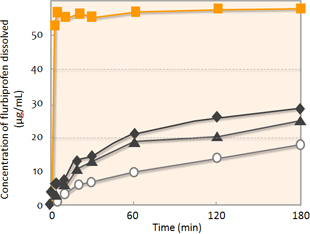
Dissolution profiles of flurbiprofen in distilled water : (○:untreated flurbiprofen; ▲:Physical mixture of flurbiprofen/αG Hesperidin (1/10); ■: Spray-dried powders of flurbiprofen/αG Hesperidin (1/10); ◆: Spray-dried powders of flurbiprofen/αG Hesperidin (1/10)) >>

*This infomation is not intended to be used for medical purposes.